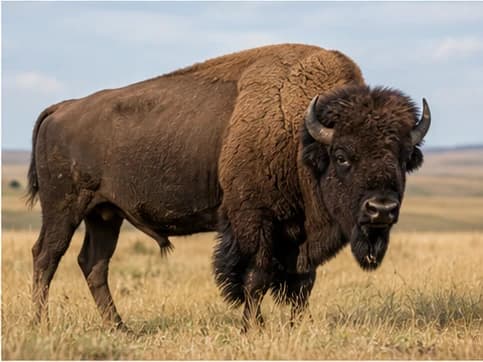
Bison have a prominent shoulder hump made of powerful muscles.
The hump is supported by long vertebrae and consists of strong muscles that help bison use their heads to clear snow from grass in winter. This adaptation is essential for winter survival on the plains.
A bison's thick coat protects it through harsh winters.
Bison have a dense woolly undercoat for insulation and a coarser outer coat. In winter, the fur grows thicker, and bison can withstand blizzards by facing into the wind.
Bison roll in dust wallows to maintain their coats.
Wallowing helps bison shed loose fur, deter biting insects, and cool off. The shallow depressions they create can persist in the landscape for years and provide microhabitats for other species.
Bison can run faster than a horse over short distances.
Despite weighing up to 900 kilograms, bison can sprint at speeds over 55 kilometers per hour. They are also agile and can turn quickly, making them surprisingly athletic for their size.
Bison live in herds that once numbered in the millions.
Before the 1800s, an estimated 30 to 60 million bison roamed North America. Their seasonal movements shaped the Great Plains ecosystem, and herds still migrate today in protected areas.
The American bison is a major conservation success story.
By 1889, fewer than 1,100 American bison remained after systematic slaughter. Through the efforts of ranchers, conservationists, and government programs, the population has recovered to about 500,000, mostly in commercial herds.