
Anatomy
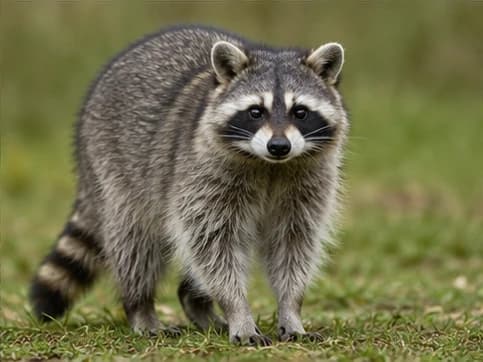
Raccoons have a distinctive black mask and ringed tail.
The dark fur around the eyes reduces glare and may help with night vision. The 4 to 10 alternating dark and light rings on the tail are a reliable field mark for identification.
Procyon lotor
Raccoons are medium-sized mammals instantly recognizable by their black facial mask and ringed tail. Their nimble front paws, curious nature, and remarkable adaptability have made them one of the most successful urban wildlife species in North America.
Scientific name
Procyon lotor
Animal group
Mammal
Diet
Omnivore
Habitat
Forests, wetlands, and urban areas
Range
North America; introduced in Europe and Japan
Activity
Mostly nocturnal
Explained facts
Anatomy
The dark fur around the eyes reduces glare and may help with night vision. The 4 to 10 alternating dark and light rings on the tail are a reliable field mark for identification.
Adaptation
Their forepaws have many sensory receptors, almost like a second set of eyes. Raccoons frequently manipulate objects, open containers, and explore their environment by touch.
Diet
They eat fruits, nuts, insects, crayfish, frogs, eggs, small mammals, birdseed, and human food scraps. This flexible diet is a key reason for their success in diverse habitats.
Behavior
They den in attics, chimneys, and sheds, and forage in gardens, trash cans, and compost piles. Their intelligence and dexterity let them open latches, lids, and simple locks.
Behavior
The species name lotor means 'washer' in Latin. When near water, raccoons may dunk and rub food items, possibly to moisten them or remove unwanted parts.
Adaptation
Studies show raccoons can solve complex problems, remember solutions for years, and learn from observing others. Their cognitive abilities rival those of some primates.
The raccoon is a medium-sized mammal native to North America. Its black facial mask, agile forepaws, and bushy ringed tail make it one of the most recognizable wild animals on the continent.
Raccoons belong to the family Procyonidae, which also includes coatis, kinkajous, and olingos. They are not closely related to bears or dogs despite a superficial resemblance.
Raccoons are native to North America, from southern Canada through the United States and into Central America. They have also been introduced to Europe, Japan, and the Caucasus region.
They prefer wooded areas near water but are equally at home in suburbs and cities. Tree cavities, rock crevices, abandoned burrows, and human structures all serve as dens.
Raccoons are true omnivores, eating whatever is abundant in their environment. Their diet shifts with the seasons: fruits and nuts in summer and fall, more animal protein in spring.
Their sensitive forepaws help them find and identify food in murky water, under leaves, or inside crevices. This tactile exploration is central to how they forage.
Raccoons are mainly nocturnal, spending the day resting in dens and emerging at dusk to forage. They are generally solitary but may gather at abundant food sources.
Their intelligence and adaptability allow them to remember locations of food sources for years, navigate complex urban environments, and open containers that would defeat many other animals.
The dark mask around the eyes may help reduce glare and improve night vision, similar to the dark markings athletes wear under their eyes.
Urban raccoons eat a mix of natural food and human scraps: fruit, insects, pet food, birdseed, compost, and trash. Their adaptable diet is key to their success.
Raccoons are generally wary of people but can become bold in urban areas. They can carry diseases such as rabies and roundworm, so it is best to observe them from a distance and never feed them.