Random Animal Generator logo

Random Animal Generator

Tool-first animal discovery

Castor

Beaver Facts

Beavers are large, semi-aquatic rodents famous for their ability to transform landscapes by building dams and lodges. They are ecosystem engineers whose activities create wetlands that benefit countless other species across North America and Europe.

Beaver

Scientific name

Castor spp.

Animal group

Mammal

Diet

Herbivore

Habitat

Rivers, streams, and wetlands

Range

North America, Europe, and parts of Asia

Activity

Mostly nocturnal, active year-round

Explained facts

6 Interesting Beaver Facts

Adaptation

Beavers are ecosystem engineers that build dams and lodges.

By damming streams, beavers create ponds that slow water flow, reduce erosion, and provide habitat for fish, amphibians, insects, and waterfowl. These wetlands can persist long after the beavers leave.

Anatomy

A beaver's flat tail has multiple functions.

The broad, scaly tail serves as a rudder while swimming, a prop for balance when sitting upright, a store of fat, and a warning signal when slapped against the water's surface.

Anatomy

Beaver teeth never stop growing.

Like all rodents, beavers have incisors that grow continuously throughout life. Chewing on wood keeps the teeth worn to a sharp chisel edge, ideal for felling trees.

Adaptation

Beavers can stay underwater for up to 15 minutes.

Special nostrils and ears that close underwater, a third transparent eyelid, and efficient oxygen storage allow beavers to work on their dams and lodges underwater for extended periods.

Behavior

Beavers live in family colonies.

A colony usually consists of an adult breeding pair, their kits from the current year, and yearlings from the previous year. Young beavers typically disperse at age two to find their own territory.

Behavior

Beavers use scent mounds to mark territory.

Beavers build small mounds of mud and vegetation and cover them with castoreum, a pungent oil produced in their castor sacs. These scent marks communicate the colony's presence to other beavers.

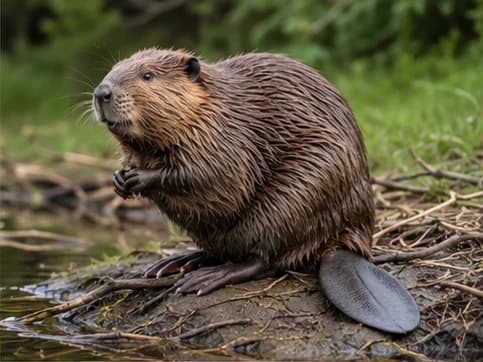
What is a beaver?

Beavers are the second-largest living rodents after the capybara. Two species exist: the North American beaver and the Eurasian beaver, both master builders of dams and lodges.

Their ability to alter entire waterways has earned them the title of ecosystem engineers, creating habitats that support biodiversity far beyond what would exist without their activity.

Dams, lodges and habitat

Beavers build dams from branches, mud, and stones to create deep, slow-moving ponds. In the center of the pond they build a lodge with an underwater entrance, keeping predators out and providing safe living space.

The ponds created by beaver dams trap sediment, filter pollutants, raise the water table, and create thriving wetland ecosystems. Many species of birds, fish, amphibians, and mammals depend on these beaver-created habitats.

Diet and foraging

Beavers are herbivores that eat tree bark, leaves, twigs, roots, and aquatic plants. They prefer softwood trees such as aspen, poplar, willow, and birch, and can fell large trees with their powerful incisors.

They store food underwater near the lodge for winter, creating a submerged cache of branches that lets them feed even under ice. This food storage behavior is essential for survival in cold climates.

Family life and communication

Beaver colonies are stable family units. Kits are born in spring and remain with their parents for two years, learning dam-building, foraging, and territorial defense before dispersing.

Communication includes tail slaps on water to warn of danger, whines and grunts between family members, and scent marking with castoreum to define territory boundaries.

Beaver FAQ

Why do beavers build dams?

Beavers build dams to create deep ponds that provide safe access to food, protect their lodge entrances from predators, and allow them to travel underwater even in winter.

What do beavers eat?

Beavers are herbivores that eat bark, leaves, twigs, roots, and aquatic plants. They especially favor aspen, poplar, willow, and birch.

How long can beavers stay underwater?

Beavers can stay submerged for up to 15 minutes, thanks to nostrils and ears that seal underwater, a clear third eyelid, and efficient oxygen storage.

Sources

  • Beaver - San Diego Zoo Animals & Plants. Accessed 2026-07-18.