
Record
Moose are the largest living deer species.
Adult male moose can stand over 2 meters tall at the shoulder and weigh up to 700 kilograms. Their massive size sets them apart from all other deer species.
Alces alces
Moose are the largest members of the deer family, found across the boreal forests of North America and northern Europe. Their towering size, palmate antlers, long legs, and ability to forage in water make them one of the most impressive mammals of the north.
Scientific name
Alces alces
Animal group
Mammal
Diet
Herbivore
Habitat
Boreal forests, wetlands, and tundra edges
Range
Canada, Alaska, northern United States, Scandinavia, and Russia
Conservation status
Least concern
Explained facts
Record
Adult male moose can stand over 2 meters tall at the shoulder and weigh up to 700 kilograms. Their massive size sets them apart from all other deer species.
Anatomy
Unlike the branching antlers of most deer, moose antlers are shovel-shaped with multiple points along the outer edge. A bull's antlers can span over 1.5 meters and are shed each winter.
Adaptation
Their long legs and hollow guard hairs make them strong swimmers. Moose can paddle at speeds up to 10 kilometers per hour and will readily cross lakes and rivers to reach feeding areas or escape predators.
Adaptation
With legs over a meter long, moose can wade through snow that would stop most other hoofed mammals. This helps them access winter browse that other deer cannot reach.
Diet
Moose wade into ponds and lakes to eat water lilies, pondweed, and other submerged vegetation. Aquatic plants provide valuable sodium and other minerals.
Behavior
Unlike many deer that form herds, moose typically live alone. The main social bond is between a cow and her calves. Bulls associate with cows only during the autumn breeding season.
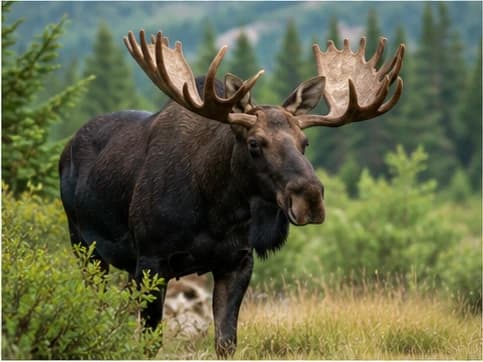
The moose is the largest living deer species, instantly recognizable by its towering height, long legs, bulbous nose, and the palmate antlers of adult males. In Europe it is called an elk.
Moose are adapted to cold northern climates and live across the boreal forests and mixed woodlands of North America, Scandinavia, and Russia.
Moose have a distinctive appearance: a heavy body on long legs, a large drooping nose, a flap of skin called a bell under the chin, and a short tail. Their coat is dark brown to almost black.
Bull moose grow antlers each spring and summer, covered in velvety skin that supplies blood for growth. By autumn, the velvet is shed and the antlers are solid bone, used for displays and sparring during the rut.
Moose are herbivores that browse on leaves, bark, and twigs of woody plants. Willow, aspen, birch, and maple are important year-round foods. In summer they supplement their diet with aquatic plants.
During winter, moose rely on stored body fat and the twigs and bark they can reach. Deep snow can make foraging difficult, and a moose may lose up to 20 percent of its body weight over winter.
Moose are most active at dawn and dusk. In summer they spend much of their time feeding in and around water. In winter they move less and conserve energy by using trails through deep snow.
Calves are born in late spring after an eight-month gestation. They can stand and walk within hours and stay with their mother for about a year before she drives them away before the next birth.
Adult bull moose can stand over 2 meters at the shoulder and weigh up to 700 kilograms, making them the largest living deer species.
Moose are herbivores that eat leaves, twigs, bark of trees like willow and aspen, and aquatic plants such as water lilies and pondweed.
Moose are generally not aggressive but can become defensive, especially cows with calves or bulls during the mating season. They are large and powerful, so it is important to give them plenty of space.