
Record
Cheetahs are the fastest land mammals.
They are adapted for intense, short bursts of speed rather than long-distance running, which helps them catch agile prey.
Acinonyx jubatus
Cheetahs are slender, spotted cats specialized for fast, short sprints. They live mainly in eastern and southern Africa, where their flexible bodies, long tails, and efficient breathing help them catch prey in open habitats.
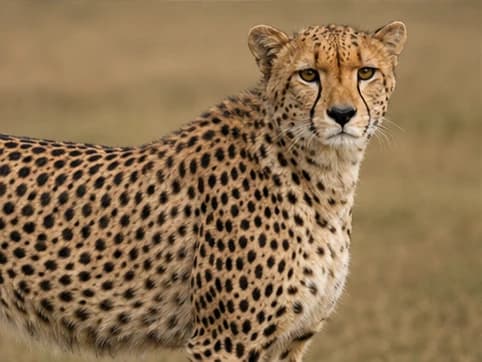
Scientific name
Acinonyx jubatus
Animal group
Mammal
Diet
Carnivore
Habitat
Open grasslands and other African landscapes
Range
Mainly eastern and southern Africa, with small populations elsewhere
Conservation status
Threatened
Explained facts
Record
They are adapted for intense, short bursts of speed rather than long-distance running, which helps them catch agile prey.
Adaptation
The long tail acts like a rudder, helping the cat keep its direction while it turns at speed after fleeing prey.
Anatomy
The dark lines running from the eyes toward the mouth are called malar stripes and are a familiar field mark of the species.
Behavior
Females usually live independently except when raising young, while related males, often brothers, can form small groups called coalitions.
Behavior
They communicate with sounds including chirps, purrs, growls, hisses, and bleats instead of the roar used by some other big cats.
Behavior
A cheetah often stalks to within about 50 meters before charging, because even its remarkable speed can only be maintained for a short distance.
The cheetah is a cat built around speed: it has a long, light body, a flexible spine, long legs, and a tail used for balance and steering.
Most cheetahs live in eastern and southern Africa, with small populations also occurring in North Africa and Iran.
A cheetah's enlarged nostrils, lungs, and heart support intense effort during a sprint. Its tail helps the cat change direction as prey turns.
These adaptations make cheetahs exceptional sprinters, but they are intended for quick chases rather than endurance.
Cheetahs hunt alone and use stalking before a fast chase. Getting close before accelerating gives them the best chance of success.
Their diet is made of animal prey, and not every chase succeeds; speed is only one part of successful hunting.
Female cheetahs generally live alone except when raising cubs. Some related males form coalitions that travel and live together.
Cheetahs are vocal in ways people may not expect, using chirps and other calls to communicate.
Their long, flexible bodies, powerful heart and lungs, enlarged nostrils, and steering tail are all adapted for short, intense sprints.
No. Cheetahs use chirps, purrs, growls, hisses, and other calls, but they cannot roar like lions or tigers.
Females are usually independent except with cubs. Related males may form small groups called coalitions.