
Anatomy
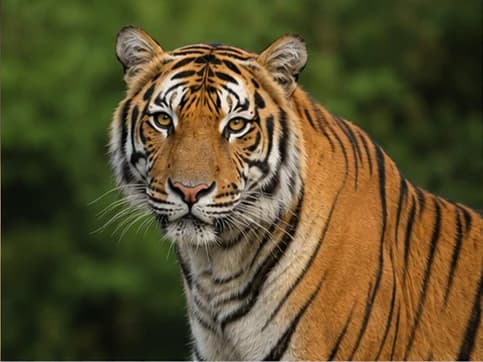
Every tiger has a unique stripe pattern.
Researchers can use the pattern of dark stripes on a tiger's coat to recognize individual animals, much as people use distinctive physical features to tell individuals apart.
Panthera tigris
Tigers are powerful, mostly solitary big cats built for stalking prey in Asia's forests, grasslands, wetlands, and mangroves. Their striped coats, quiet movement, and comfort in water make them especially distinctive among cats.
Scientific name
Panthera tigris
Animal group
Mammal
Diet
Carnivore
Habitat
Forests, grasslands, wetlands, mangroves, and taiga
Range
Parts of Asia
Conservation status
Endangered
Explained facts
Anatomy
Researchers can use the pattern of dark stripes on a tiger's coat to recognize individual animals, much as people use distinctive physical features to tell individuals apart.
Behavior
A tiger moves slowly and quietly, using cover to get close before making a short final rush. This method is more effective than trying to chase prey over a long distance.
Adaptation
In long grass and wooded habitats, the contrast of the coat can make a waiting tiger harder for prey to recognize as a single large animal.
Adaptation
Unlike many cats, tigers readily enter water. They may rest near ponds, streams, and rivers, and their partially webbed toes help when they swim.
Adaptation
San Diego Zoo notes that tiger night vision is about six times better than ours, which helps when these predators are active in low light.
Record
The surviving subspecies occupy different Asian habitats, from tropical forests and mangroves to arid forests and northern taiga.
The tiger is the largest living cat species. It is a muscular carnivore with a striped coat, large canine teeth, and retractable claws.
Wild tigers live in several types of Asian habitat, but their populations are much more fragmented than they were historically.
Tiger subspecies use very different landscapes, including flooded mangrove forests, tropical forests, dry forests, and taiga. Access to cover, prey, and water is important.
Tigers are seldom far from water and can cross rivers when necessary, which helps connect parts of their habitat.
Tigers mainly hunt hoofed mammals such as deer and pigs. They stalk patiently, then use powerful jaws and forelimbs to bring prey down.
After feeding, a tiger may cover leftovers with grass and dirt and return to the carcass later.
Tiger conservation requires protecting connected habitat, prey populations, and the people who share landscapes with tigers.
The species is endangered, and some subspecies face particularly severe risks.
Tigers live in parts of Asia, using habitats that include tropical forests, mangroves, dry forests, wetlands, and taiga.
Tigers are powerful swimmers and often use ponds, streams, and rivers. They may swim to cool off or cross water while moving through their range.
Their stripes help break up the outline of the body in vegetation, giving a stalking tiger useful camouflage.