
Adaptation
The scientific name Ursus maritimus means 'sea bear.'
Polar bears are adapted swimmers and live throughout the Arctic where sea ice helps them hunt seals.
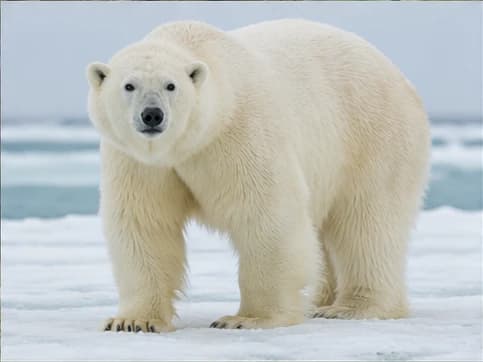
Polar bears are Arctic marine mammals adapted to hunting seals from sea ice. Their swimming ability, sensitive sense of smell, insulated bodies, and denning behavior are closely tied to the frozen ocean environment.
Scientific name
Ursus maritimus
Animal group
Mammal
Diet
Mostly seals
Habitat
Arctic sea ice
Social life
Mostly solitary
Conservation pressure
Sea-ice loss
Explained facts
Adaptation
Polar bears are adapted swimmers and live throughout the Arctic where sea ice helps them hunt seals.
Diet
Polar bears wait at breathing holes and cracks in sea ice, relying on seals for the high-energy diet they need.
Behavior
Except for pregnant females in dens, polar bears continue hunting through winter when conditions allow.
Adaptation
Their strong sense of smell can locate seals on the ice and help find breathing holes under snow.
Adaptation
Their broad front feet paddle while their hind legs help steer, allowing long swims in search of food or ice.
Reproduction
A pregnant female uses a maternity den during pregnancy and the first months of a cub's life, relying on stored body fat.
The polar bear is a marine mammal and the largest bear species, adapted to the cold Arctic Ocean and its sea ice.
Broad front feet provide paddling power, while hind legs act as rudders when swimming.
Polar bears use patient sit-and-wait hunting at seal breathing holes rather than long chases.
Sea ice gives bears access to seals; when ice is absent, other foods do not reliably replace this high-calorie prey.
Pregnant females dig maternity dens, usually in snow, and give birth there during winter.
Cubs are born tiny and depend on their mother for warmth and rich milk before they explore outside the den.
Loss of Arctic sea ice makes it harder for polar bears to hunt and can force them to travel farther or spend more time on land.
Safeguarding habitat and reducing climate impacts are central to polar bear conservation.
Most do not. Pregnant females den over winter, while other bears can continue hunting when conditions allow.
They mainly eat seals, especially ringed seals, hunted from sea ice.
Sea ice gives polar bears access to seal prey and hunting areas; without it, they struggle to obtain the same reliable, high-energy diet.