
Anatomy
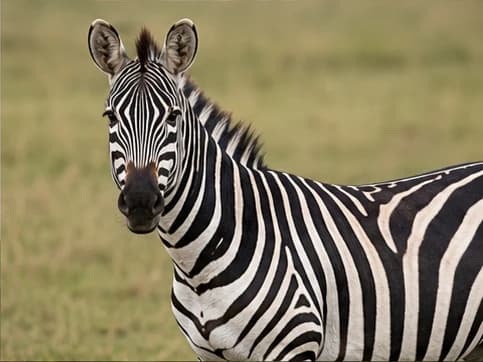
Every zebra has a unique stripe pattern.
Individual stripe patterns help researchers recognize zebras, and young foals learn their mother's pattern.
Equus spp.
Zebras are African members of the horse family, famous for individual stripe patterns, social lives, and powerful defenses. Plains, mountain, and Grevy's zebras use different habitats and face different conservation pressures.
Scientific name
Equus spp.
Animal group
Mammal
Diet
Herbivore
Habitat
African grasslands, woodlands, and dry slopes
Species
Plains, mountain, and Grevy's zebra
Family
Horse family
Explained facts
Anatomy
Individual stripe patterns help researchers recognize zebras, and young foals learn their mother's pattern.
Record
The plains, mountain, and Grevy's zebras differ in size, stripe patterns, habitats, and social systems.
Behavior
A zebra's kick can seriously injure predators; hearing, vision, speed, and herd vigilance add further protection.
Reproduction
Foals can walk within about 20 minutes and run after about an hour, helping them keep up as the herd moves.
Behavior
When zebras rest at night, one may stand watch to reduce the chance of a surprise ambush.
Conservation
Habitat loss, poaching, and disease affect zebras, and the source describes the Grevy's zebra as Endangered.
Zebras are equids, the animal family that also includes horses. They have sturdy bodies, bristly manes, and striped coats.
Although they look similar at a glance, the three zebra species have distinct physical traits and lifestyles.
Zebras are herbivores that mainly graze on grasses, while occasionally browsing leaves and stems.
Their habitats range from East African grasslands to southern African woodlands and more arid landscapes.
Plains and mountain zebras commonly live in family groups that may gather into larger herds. Grevy's zebras have a different, less permanent social system.
Zebras use sounds, facial expressions, ear positions, and grooming to communicate.
Habitat loss, poaching, and disease can threaten zebra populations, though the scale of the risk differs by species.
Protecting grasslands and working with local conservation partners is especially important for Grevy's zebra.
Yes. Each zebra has an individual stripe pattern, which can help researchers identify it.
Zebras are herbivores that mostly graze on grasses.
There are three: plains, mountain, and Grevy's zebra.